Every stock wheel rolling off a production line is engineered to a single specification. That specification is built around a rider who doesn’t exist… a statistical average, derived from a market segment, costed to a margin. If you fall outside that average in any meaningful way, the wheel was never designed for you.
This matters most when it comes to rider weight. Not because heavier riders are harder on equipment in some vague, general sense, but because the forces involved are real, measurable, and completely ignored by the spec sheets attached to most off-the-shelf wheels.
Check the spec sheet on almost any new bike. The wheels are almost always listed last.
An afterthought designed to save the bike manufacturer as much money as possible.
I see this all the time. Generic rims laced to house-brand or low-end hubs with plain-gauge spokes, and cheap alloy nipples. And very often these days, with 28 spokes per wheel instead of 32.
4 less spokes per wheel, over thousands of wheels, saves the bike brands millions of dollars each year.
What “average” actually means in wheel manufacturing
Most production wheelsets are tested and rated against a system weight – rider plus bike plus kit – that assumes a fairly narrow range. The industry target has historically sat around 75–85kg total system weight. Some brands are more transparent about this than others. Most aren’t transparent at all.
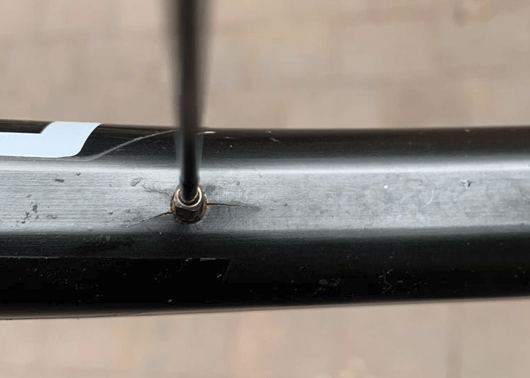
Push beyond that range and a few things happen. Spokes lose tension, causing the wheel to go out of true, and resulting in premature spoke breakage. Rims start cracking at the spoke holes. The wheel that felt fine at first becomes the wheel that needs truing every few months, then every few weeks.
Most riders blame themselves. They shouldn’t. They were sold a bike with wheels that weren’t built for them.

The actual problem: spoke count, tension, and what production skips
In the push toward cheaper, lighter, more cost effective wheels, production manufacturers have cut spoke counts aggressively. 24-28 spoke wheels on mountain bikes are now commonplace. This works beautifully for a 68kg rider on a smooth road. It starts to become a liability for anyone carrying more weight, riding longer distances, or doing any meaningful offroad riding.
Fewer spokes means each spoke carries a greater share of the load. It means less redundancy when one fatigues or breaks. It means the rim takes more of the impact directly, because there’s less of a web of tension distributing it. This isn’t my opinion. It’s physics.
A custom-built wheel addresses this at the component selection stage – before a single part is sourced. Spoke count is chosen for the rider’s weight and discipline. Rim depth and profile are matched to the use case. Hub quality is selected for longevity and lifetime value, not just for the price point that fits the production run. Then the build itself, the lacing pattern, the tension, the stress-relieving and final truing, is done by hand, spoke by spoke, with the specific rider in mind.
Durability is not the same as weight
There’s a persistent confusion in cycling culture that lighter automatically means better. For many riders, in many contexts, it does. But durability and weight are not the same axis. A heavier rim with the right profile, built with the right spoke count and laced properly, will outlast a lightweight production wheel several times over under the right conditions.
Heavier riders don’t need heavy wheels. They need well-built wheels, selected and tensioned for the loads they’ll experience in reality. That distinction is the entire point of a custom build.
A wheel that stays true and intact is faster than a wheel that breaks halfway through a stage race.
Hand-built wheels are fundamentally different
The build process is where the difference becomes concrete. In production, wheels are machine-laced, tensioned to a general specification, and quality-checked to a tolerance that covers the average case. Speed is the priority. Consistency at scale is the goal.
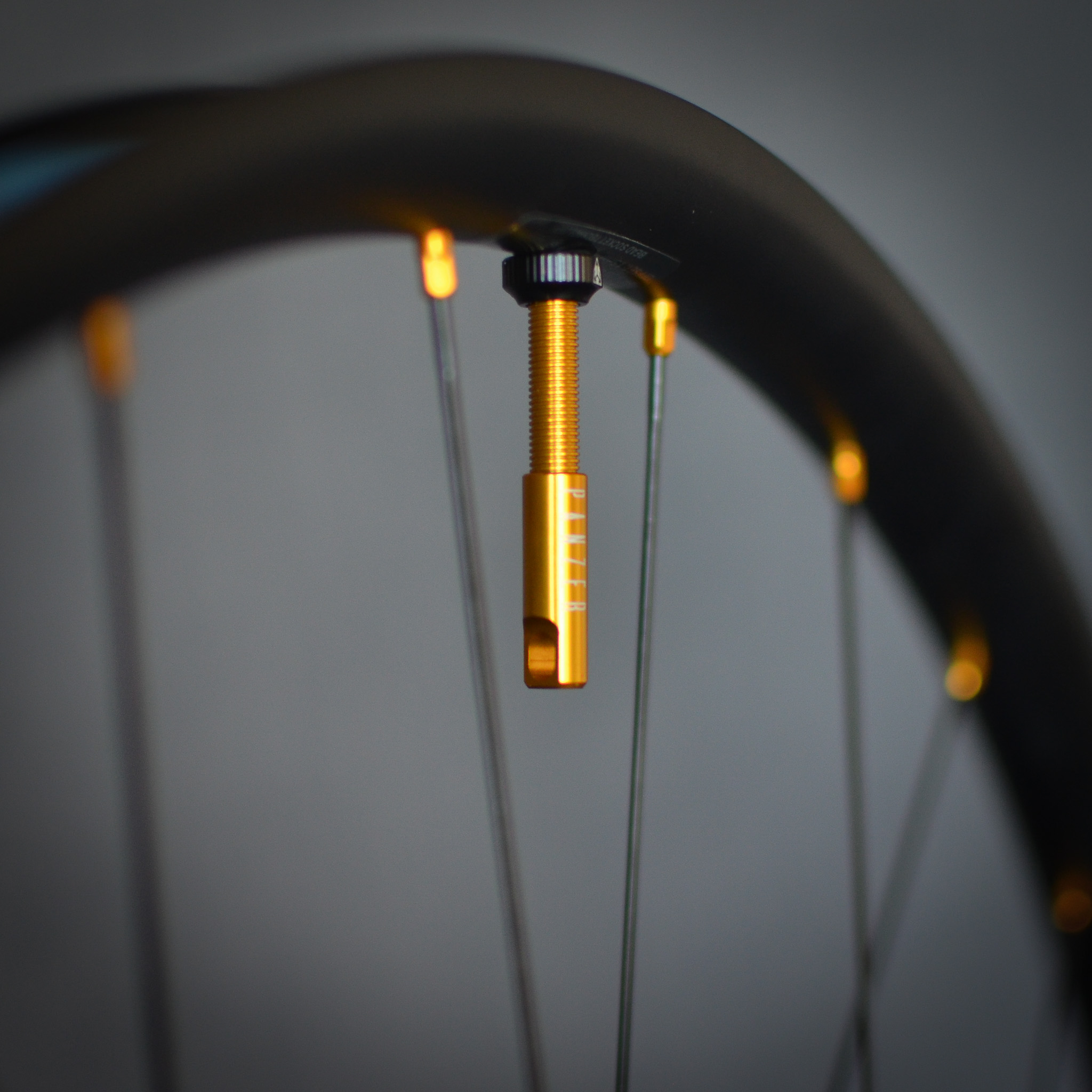
In a custom wheel build, spoke tension is checked and adjusted at every spoke, multiple times. The wheel is stress-relieved, a process of applying load to properly seat and untwist the spokes, which production typically skips or rushes. The result is a wheel that settles into its final tension properly and stays there. That’s why hand-built wheels hold their true. Not because of some mystical craft element, but because the process allows for the kind of attention that machine production can’t justify economically.
And no. A wheel shouldn’t have to be re-tensioned or trued after a short break-in period.
For heavier riders, this matters more, not less. The margin between a wheel that stays reliable and one that slowly deteriorates is often just the quality of the initial build.
Read: MTB wheels where heavy duty is required
The build conversation starts before the parts order
Every wheel I build starts with a conversation about the rider: weight, discipline, road surface, goals, budget. That conversation determines which rims, which hubs, which spokes, which lacing pattern. None of it is guesswork. Each combination is a considered response to a specific set of requirements.
That’s the part mass production can’t do. Because their model doesn’t allow for it, and they care more about profit than the needs of the individual rider. A custom build, by definition, begins where the production model ends.
If you’ve been tolerating wheels that need constant attention, or you’ve just accepted that your wheels “don’t last as long” as other riders’, it’s worth exploring a custom wheel build, assembled to suit you, your riding style and your bike.
Click through, request a free, no-obligation quote and start thinking about what your riding would be like if you never had to worry about whether or not your wheels will survive your next ride.
No responses yet